
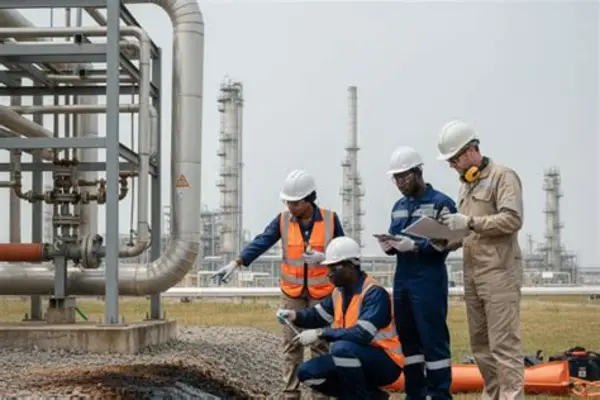
Most students who want to work in oil and gas think of one course: Petroleum Engineering. That course is competitive, and it is far from the only route in. The industry also hires chemical, mechanical, electrical, marine and civil engineers, geologists, geophysicists, chemists, environmental specialists, accountants, lawyers and supply chain professionals. This guide matches each career to the courses that lead toward it, so you choose with a clear target and a backup.
No course guarantees an oil and gas job. The industry moves with oil prices, regulation and company decisions, and employers hire on skill as much as on certificates. A course that builds strong, transferable skills protects you if the market shifts.
How the Industry Is Organised
Oil and gas work splits into three broad stages.
- Upstream covers exploration, drilling and production, where geologists, geophysicists and petroleum, drilling and reservoir engineers work.
- Midstream covers pipelines, storage, transport and gas processing, where chemical, mechanical, civil and marine engineers work.
- Downstream covers refining, distribution and marketing, where chemical engineers, process specialists, accountants and marketers work.
Beside these stages, service companies, regulators, finance teams, legal departments, safety units and procurement teams all hire graduates. Decide which stage and which function interest you most before you choose a course.
Petroleum Engineering and Natural Gas Engineering
Petroleum Engineering is the most direct route into upstream work. It teaches reservoir engineering, drilling, production and the economics of oil fields. The University of Benin has taught it as an independent department since 1984, and the University of Port Harcourt runs Petroleum Engineering alongside Gas, Chemical and Environmental Engineering. The Federal University of Petroleum Resources, Effurun, trains students in Petroleum Engineering and Natural Gas Engineering as part of its petroleum-focused programme list.
Petroleum Engineering ranks among the most competitive engineering courses, so keep related options ready. Natural Gas Engineering suits you if you want to work on gas processing and transport, a growing part of the industry.
Other Engineering Courses
Several engineering courses lead into oil and gas.
- Chemical Engineering feeds refining, gas processing and petrochemical work, and many companies treat it as a close cousin of Petroleum Engineering.
- Mechanical Engineering feeds rotating equipment, pipelines, drilling rigs and maintenance work.
- Electrical and Electronic Engineering feeds power systems, instrumentation and control.
- Civil Engineering feeds facilities, pipelines, roads and offshore structures.
- Marine Engineering feeds offshore vessels, rigs and shipping linked to the industry.
Engineering is a regulated profession, so confirm that your programme holds accreditation from the Council for the Regulation of Engineering in Nigeria before you commit.
Geology, Geophysics and Earth Sciences
Finding oil and gas starts with earth science. Geology and Geophysics graduates interpret rock formations, analyse seismic data and help decide where to drill. Related courses such as Applied Geophysics and Geoscience support exploration teams, and mud logging and well-site roles also draw on them. These courses suit students who enjoy fieldwork, data and puzzle-solving more than design and construction.
Chemistry and Environmental Courses
Chemistry, Industrial Chemistry and Chemical Technology lead to laboratory, quality control, refining and petrochemical work. Environmental Management, Environmental Science and related courses lead to roles in pollution control, remediation, environmental impact assessment and regulatory compliance. These roles carry growing weight as regulators and communities demand cleaner operations, especially in the Niger Delta.
Business, Finance and Law Courses
The industry runs on contracts, money and compliance as much as on drilling.
- Accounting, Banking and Finance lead to roles in joint venture accounting, project finance, auditing and treasury.
- Law leads to roles in contracts, regulatory work, land and environmental law and dispute resolution. Make sure your faculty holds approval from the Council of Legal Education.
- Business Administration, Marketing and Supply Chain Management lead to roles in procurement, logistics, contracting and sales.
- Petroleum administration and management programmes lead to roles that blend technical knowledge with management.
These courses often carry lower cut-offs than the engineering routes, and they give you a way into the industry without a technical degree.
Computing and Data Courses
Oil and gas companies now rely heavily on data, automation and digital systems. Computer Science, Computer Engineering, Information Technology and Data Science graduates work on modelling, monitoring, cybersecurity and software tools. If you enjoy technology more than rigs and pipelines, this route offers a modern way in.
Technical Routes: ND and HND
Not every career starts with a degree. The Petroleum Training Institute in Effurun, established by an act of the National Assembly in 1972, trains technicians and skilled workers for the industry. It runs National Diploma and Higher National Diploma programmes in areas such as Petroleum and Natural Gas Processing Technology, and the Ministry of Petroleum Resources owns it. Technicians keep plants running, so these roles stay in demand.
Graduates of these programmes can also pursue Direct Entry into relevant university courses later. Check each university’s rules before you plan that step.
Match Your Career Goal to a Course
| Career goal | Courses to consider |
|---|---|
| Reservoir, drilling or production engineer | Petroleum Engineering, Chemical Engineering, Mechanical Engineering |
| Gas processing engineer | Natural Gas Engineering, Chemical Engineering |
| Refinery or process engineer | Chemical Engineering, Petroleum Engineering |
| Pipeline or facilities engineer | Civil, Mechanical or Chemical Engineering |
| Instrumentation and control engineer | Electrical and Electronic Engineering, Computer Engineering |
| Offshore and marine engineer | Marine Engineering, Mechanical Engineering |
| Geologist or geophysicist | Geology, Geophysics, Applied Geosciences |
| Laboratory or quality control scientist | Chemistry, Industrial Chemistry |
| Environmental officer | Environmental Management, Environmental Science, Chemistry |
| Finance or joint venture accountant | Accounting, Banking and Finance |
| Industry lawyer | Law |
| Procurement or supply chain officer | Supply Chain Management, Business Administration, Marketing |
| Digital and data specialist | Computer Science, Data Science, Computer Engineering |
| Plant technician | ND or HND in Petroleum and Natural Gas Processing Technology |
Universities That Train for the Industry
Several schools build their training around the sector.
- Federal University of Petroleum Resources, Effurun, Delta State. A specialised petroleum university that groups its programmes into colleges including Engineering and Technology, Science, Computing, Maritime and Offshore Studies, and Petroleum Administration and Management. Its engineering list includes Petroleum, Natural Gas, Chemical, Marine, Mechanical, Civil, Electrical and Electronic, and Computer Engineering.
- University of Port Harcourt, Rivers State. A federal university in the heart of the oil region, with Petroleum, Gas, Chemical and Environmental Engineering and an Institute of Petroleum Studies.
- University of Benin, Edo State. A long-established engineering faculty with Petroleum Engineering as its own department.
Many other federal, state and private universities also run engineering and science courses that feed the industry. Whichever school you pick, check the accreditation of your exact programme.
Admission Requirements
Engineering and earth science courses usually expect English Language, Mathematics, Physics and Chemistry at UTME, and Geology and Geophysics may accept alternatives such as Biology in place of one subject. Accounting, Law and business courses follow their own subject lists. Your O’Level result should carry five credits, including English Language and Mathematics, and the relevant science subjects for technical courses.
JAMB set the national minimum UTME score at 150 for 2026/2027, and each department sets a higher cut-off of its own. Petroleum Engineering and Chemical Engineering rank among the most competitive courses at well-known schools, so check the current figure for each one. If your score sits below those cut-offs, consider Geology, Chemistry, Environmental Management or an ND route instead of giving up on the industry.
What Matters Beyond the Certificate
Employers in this industry hire people who show practical skill and discipline.
- Take industrial training seriously. Use your placement periods to learn the work and meet people.
- Learn the software. Practise the tools your field uses, such as modelling, simulation, data and design software.
- Get safety training. Health, safety and environment awareness matters across the sector.
- Join professional bodies. Register with the regulator for your profession as soon as you qualify.
- Build transferable skills. Strong analysis, communication and project skills help if the market shifts.
- Network. Meet working professionals through lecturers, alumni and industry events.
Common Mistakes to Avoid
- Assuming Petroleum Engineering is the only way into oil and gas
- Ignoring the industry’s cycles and choosing a course with no flexibility
- Skipping accreditation checks on engineering and law programmes
- Relying on the certificate alone without practical training
- Believing claims of guaranteed jobs from agents or schools
- Paying an agent or an unofficial account for admission
Frequently Asked Questions
What is the best course for an oil and gas career in Nigeria?
Petroleum Engineering is the most direct route, but Chemical Engineering, Geology, Mechanical Engineering and several business and technical courses also lead into the industry.
Can I work in oil and gas without Petroleum Engineering?
Yes. The industry hires engineers from many disciplines, geoscientists, chemists, accountants, lawyers, environmental specialists and supply chain professionals.
Is there a university dedicated to petroleum?
Yes. The Federal University of Petroleum Resources in Effurun, Delta State, specialises in petroleum-related engineering, science and management.
What JAMB subjects do I need for Petroleum Engineering?
Most universities expect English Language, Mathematics, Physics and Chemistry.
Is Petroleum Engineering hard to get into?
Yes. It ranks among the most competitive engineering courses, so keep related courses as backups.
Can I enter the industry with an ND or HND?
Yes. Institutions such as the Petroleum Training Institute train technicians and skilled workers for plant and field roles.
Conclusion
The best courses for oil and gas careers depend on the role you want. Petroleum and Natural Gas Engineering lead most directly into upstream and gas work, other engineering courses feed refining, pipelines, power and offshore roles, and Geology, Chemistry, Environmental, business, law and computing courses open the rest of the industry. Pick a course that matches your target and keeps your options open, confirm accreditation, take your training seriously and build skills that travel. The industry rewards people who can do the work, whatever route brought them there.



No comments yet. Be the first to share your thoughts.