
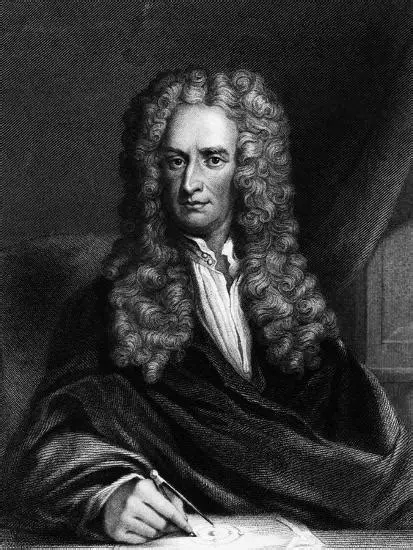
Sir Isaac Newton was an English mathematician, physicist, astronomer, and natural philosopher whose work helped establish the foundations of classical physics. He is best known for formulating the three laws of motion and the law of universal gravitation, contributions that transformed how scientists explained the movement of objects on Earth and the motion of planets in space. His research also advanced mathematics and optics, particularly the study of light and colour.
Newton’s influence extended beyond scientific discoveries. He studied and taught at the University of Cambridge, served as president of the Royal Society, and held senior positions at the Royal Mint in London. His major publications, especially Philosophiæ Naturalis Principia Mathematica and Opticks, became important works in the history of science.
For students researching the history of mathematics, physics, and scientific education, Newton’s biography offers an opportunity to understand how observation, mathematical reasoning, experimentation, and sustained research can change established explanations of the natural world. His achievements continue to influence scientific education and research centuries after his death.
Isaac Newton Biography at a Glance
- Full name: Sir Isaac Newton
- Date of birth: 25 December 1642, according to the calendar then used in England, equivalent to 4 January 1643 in the modern Gregorian calendar
- Place of birth: Woolsthorpe, Lincolnshire, England
- Date of death: 20 March 1727, according to the English calendar then in use, equivalent to 31 March 1727 in the Gregorian calendar
- Age at death: 84 years
- Nationality: English, within the historical Kingdom of England
- Professions: Mathematician, physicist, astronomer, and natural philosopher
- Education: The King’s School, Grantham; Trinity College, University of Cambridge
- Major discoveries: Laws of motion, universal gravitation, advances in calculus, and research on light and colour
- Famous books: Principia Mathematica and Opticks
- Major academic position: Lucasian Professor of Mathematics at Cambridge
- Major institutional roles: President of the Royal Society and Master of the Royal Mint
Early Life and Family Background
Isaac Newton was born at Woolsthorpe Manor, a country estate near the village of Woolsthorpe in Lincolnshire, England. He was born prematurely, according to historical accounts, and his father, also named Isaac Newton, had died before his birth.
His mother, Hannah Ayscough, later married Barnabas Smith, a clergyman. Following her remarriage, the young Newton spent much of his early childhood with his maternal grandmother while his mother lived with her new husband. This arrangement separated him from his mother during an important period of his development.
Newton’s childhood did not immediately point towards a career in advanced mathematics or science. His family initially expected him to take responsibility for agricultural work. However, he showed greater interest in learning and mechanical activities than in managing the family farm.
He attended the King’s School in Grantham, where he received the education that prepared him for university. During his school years, he became increasingly interested in learning, building objects, and understanding how things worked.
His early experiences were important to his later development, but Newton’s scientific achievements should not be attributed to childhood curiosity alone. His major discoveries emerged through years of mathematical study, experiments, reading, and the development of ideas that he later presented in scientific publications.
Isaac Newton’s Education and Qualifications
Newton attended the King’s School in Grantham, where he studied subjects that prepared him for further education. He initially faced the possibility of leaving school to work on the family farm, but he returned to formal education and continued his academic development.
In 1661, Newton entered Trinity College at the University of Cambridge. He enrolled as a student who received financial assistance in exchange for performing certain duties, a common arrangement for students in his position at the time.
Cambridge’s official curriculum was still strongly influenced by classical philosophy. Newton, however, became particularly interested in newer approaches to mathematics and natural philosophy. He studied the work of thinkers such as René Descartes and developed his own notes on philosophical and scientific questions.
His undergraduate studies introduced him to mathematical ideas that he later extended through independent research. He earned his Bachelor of Arts degree in 1665 and subsequently became a Fellow of Trinity College in 1667. He received his Master of Arts degree in 1668.
Newton’s university education was central to his scientific development. Cambridge provided access to scholarly materials, academic discussion, and a setting in which he could pursue mathematical research. Nevertheless, many of his most important early ideas developed through independent work beyond the limits of his formal lectures.
For students studying Newton’s academic background, his experience illustrates the relationship between university education and independent inquiry. Formal instruction gave him a foundation, while his own investigations allowed him to develop original approaches to difficult scientific problems.
How the Great Plague Influenced Newton’s Research
One of the most important periods in Newton’s scientific development occurred between 1665 and 1667, when outbreaks of plague disrupted university life and Cambridge temporarily closed.
Newton returned to his family home at Woolsthorpe. Away from the normal demands of university life, he devoted considerable attention to mathematics, optics, and problems involving motion and gravity.
Historians often describe this period as one of exceptional intellectual productivity. Newton developed important foundations for what became calculus, investigated the behaviour of light, and explored questions concerning motion and gravitational attraction.
The term annus mirabilis, meaning a remarkable or extraordinary year, is sometimes associated with Newton’s work during this period. However, his discoveries did not all emerge fully formed in a single year. Some ideas required further development, mathematical refinement, correspondence, and publication over many years.
The famous story of an apple falling from a tree is associated with Newton’s thinking about gravity. Historical accounts connect the falling apple with his reflections on gravitational attraction, but the popular version in which the apple struck his head should not be treated as an established fact.
Newton’s work during the plague years became an important stage in his development as a scientist. His later achievements built on ideas explored during this period and the further research he conducted after returning to Cambridge.
Isaac Newton’s Career at the University of Cambridge
After returning to Cambridge, Newton continued his mathematical and scientific research. In 1667, he became a Fellow of Trinity College, allowing him to remain within the academic environment while pursuing his interests.
In 1669, he was appointed Lucasian Professor of Mathematics, succeeding Isaac Barrow. The position was one of the most important mathematical appointments at Cambridge and provided Newton with a formal role in university teaching and scholarship.
As Lucasian Professor, Newton delivered lectures and developed ideas in mathematics and optics. His research challenged established explanations of light and contributed to a more mathematical approach to the study of nature.
Newton’s university career was not limited to classroom instruction. He also carried out experiments, developed mathematical methods, and participated in scholarly debates about scientific evidence and interpretation.
His academic work contributed to the development of mathematical physics, a field that uses mathematical relationships to describe and predict physical phenomena. Newton’s ability to connect mathematical reasoning with observations of the natural world became one of the defining features of his scientific contribution.
He eventually resigned his professorship in 1701 as his professional responsibilities shifted towards public service and scientific leadership in London.
Newton’s Three Laws of Motion
Newton’s three laws of motion are among his best-known contributions to physics. Published in Principia Mathematica in 1687, they provide a framework for understanding how forces influence the movement of objects.
First Law: The Law of Inertia
The first law states that an object remains at rest or continues moving at a constant velocity in a straight line unless acted upon by a net external force.
For example, a football lying on a field will remain at rest until a player kicks it or another force acts on it. Once it is moving, forces such as friction and air resistance affect its motion.
Second Law: Force and Acceleration
The second law explains how an object’s acceleration depends on the net force acting on it and its mass. In the familiar form used in introductory physics, the relationship is expressed as:
[
F = ma
]
Here, (F) represents the net force, (m) represents mass, and (a) represents acceleration.
For students, the equation shows that applying a greater net force to an object of constant mass produces greater acceleration. An object with greater mass requires more force to achieve the same acceleration.
Third Law: Action and Reaction
The third law states that when one object exerts a force on another, the second object exerts an equal and opposite force on the first.
When a swimmer pushes water backwards, the water exerts a force that helps move the swimmer forward. The two forces act on different objects, which is an important detail when applying the law to real situations.
Together, these laws established a systematic way of explaining motion. They remain fundamental to introductory mechanics and many practical applications in engineering, transport, construction, and other technical fields.
Isaac Newton and the Law of Universal Gravitation
Newton’s law of universal gravitation describes the gravitational attraction between objects with mass. It provided a mathematical framework for explaining why objects fall towards Earth and how celestial bodies influence one another.
Newton proposed that the same general principle of gravitational attraction could explain both the motion of objects near Earth’s surface and the orbital movement of the Moon and planets.
This was a major development because it connected phenomena that had often been studied separately. Instead of requiring entirely different explanations for earthly motion and celestial motion, Newton’s framework described them through a common physical principle.
The law of universal gravitation became a central part of Newton’s Principia Mathematica. It helped scientists calculate planetary motion and make predictions about the behaviour of astronomical bodies.
Newton’s theory was foundational, although later scientific developments refined the understanding of gravity. In the twentieth century, Albert Einstein’s general theory of relativity provided a more comprehensive description of gravitation, particularly in extreme conditions and at high levels of precision.
Newtonian gravity nevertheless remains highly useful for many everyday calculations and engineering applications because it accurately describes a wide range of situations.
Newton’s Discoveries in Mathematics
Newton made major contributions to mathematics, particularly through his development of calculus. Calculus provides methods for studying change, rates of change, accumulation, and quantities that vary continuously.
Newton developed a mathematical approach he called the method of fluxions. His work addressed problems involving motion and changing quantities, including questions that could not be handled easily by the mathematical techniques commonly used at the time.
German mathematician Gottfried Wilhelm Leibniz independently developed calculus and published his approach before Newton published his own systematic account. The resulting dispute over priority became one of the most prominent controversies in the history of mathematics.
Modern histories generally recognise Newton and Leibniz as independent developers of calculus. The notation associated with Leibniz became widely adopted, while Newton’s work remains important in the history of the subject.
Newton also made contributions to algebra and the study of infinite series. His mathematical methods supported his work in mechanics and astronomy, demonstrating how advances in mathematics can help solve problems in the physical sciences.
Calculus is now taught in universities and is used in physics, engineering, economics, computer science, and many other disciplines.
Isaac Newton’s Research on Light and Colour
Newton also made important contributions to optics, the branch of physics concerned with light and its behaviour.
Through experiments involving prisms, he investigated how white light separates into different colours when refracted. His findings challenged the idea that a prism simply created colours in otherwise colourless light.
Newton argued that white light contains different components that can be separated through refraction. He also investigated how lenses and mirrors could be used to form images.
One of his important technical achievements was the construction of a practical reflecting telescope. Unlike traditional refracting telescopes, which use lenses to collect and focus light, a reflecting telescope uses a mirror. Newton’s design helped address certain problems associated with lenses, including colour distortions.
His work on light and colour became an important part of his scientific reputation. He published Opticks in 1704, bringing together research on the behaviour of light and the results of his experiments.
The book became a significant contribution to the development of experimental optics and helped shape later scientific investigations.
Isaac Newton’s Major Books and Publications
Newton’s influence grew through scientific publications that presented his mathematical methods, experiments, and explanations of natural phenomena.
His most important works include:
- ** Philosophiæ Naturalis Principia Mathematica (1687):** Commonly known as Principia Mathematica, this work presented Newton’s laws of motion and his theory of universal gravitation. It became one of the most influential books in the history of physics.
- ** Opticks (1704):** This book presented Newton’s investigations into light, colour, refraction, and related optical phenomena.
- ** The Method of Fluxions:** Newton’s work on fluxions explained mathematical methods connected with the development of calculus. His account was published posthumously in English in 1736.
- ** Arithmetica Universalis (1707):** A work on algebra based on mathematical material associated with Newton’s teaching.
Newton also produced extensive writings on theology, biblical interpretation, chronology, and alchemy. These interests occupied a considerable part of his intellectual life, even though modern accounts of his legacy often concentrate on mathematics and physics.
His scientific publications were important not simply because they introduced new ideas but because they showed how mathematical reasoning could be used to build connected explanations of physical phenomena.
Isaac Newton at the Royal Society and the Royal Mint
Newton became a Fellow of the Royal Society in 1672, following recognition of his work on light and his reflecting telescope. The society played an important role in the development of organised scientific research in Britain.
In 1703, Newton became president of the Royal Society, a position he held until his death. During his presidency, he occupied a leading place in British scientific life and became one of the most prominent public figures associated with scientific scholarship.
Newton also moved into government service. In 1696, he was appointed Warden of the Royal Mint, and in 1699 he became Master of the Mint. His responsibilities included work related to the production and security of British currency.
His service at the Mint involved more than a ceremonial title. He took an active role in its administration and in efforts to address problems involving counterfeit coins. His appointment demonstrated that his professional abilities extended beyond academic research.
In 1705, Queen Anne knighted Newton. He thereafter became known as Sir Isaac Newton.
His career combined university scholarship, scientific leadership, and public administration, making him an influential figure in several institutions during the later part of his life.
Awards, Honours and Achievements
Newton received recognition during his lifetime for his scientific work and public service. His most significant honours and achievements include:
- Election as a Fellow of the Royal Society in 1672.
- Appointment as Lucasian Professor of Mathematics at Cambridge in 1669.
- Publication of Principia Mathematica in 1687.
- Appointment as president of the Royal Society in 1703.
- Knighthood by Queen Anne in 1705.
- Appointment as Master of the Royal Mint in 1699.
- Major contributions to classical mechanics, gravitation, calculus, and optics.
Newton’s lasting achievement was the development of a mathematical framework that connected the motion of objects on Earth with the motion of bodies in space. His work influenced the development of physics for centuries and became a foundation for further scientific research.
When Did Isaac Newton Die?
Isaac Newton died in London on 20 March 1727 according to the English calendar then in use. Under the Gregorian calendar, his death date is recorded as 31 March 1727.
He was 84 years old. Newton was buried in Westminster Abbey, London, a distinction reflecting his national standing.
His death did not end the influence of his research. His books, mathematical methods, and theories continued to shape scientific education and investigation. Later scientists extended, tested, and refined his ideas, while his original work remained central to the history of modern science.
Isaac Newton’s Legacy in Science and Education
Isaac Newton’s legacy can be seen in the way physics and mathematics are taught around the world. His laws of motion form a foundation for mechanics, while his work on gravity helps students understand the movement of objects and the behaviour of celestial bodies.
His contributions to calculus also remain important in higher education. Students in mathematics, physics, engineering, and related disciplines encounter mathematical techniques that developed partly through Newton’s research.
Newton’s work further demonstrated the value of combining mathematical analysis with observation and experimentation. His approach helped establish a model of scientific investigation in which explanations of nature could be expressed through relationships that could be tested and used to make predictions.
It is important, however, to understand his achievements in historical context. Newton built on the work of earlier thinkers, including Johannes Kepler and Galileo Galilei, and later scientists developed explanations that extended beyond Newtonian physics. Scientific progress is cumulative, and Newton’s importance lies partly in how effectively he connected and advanced ideas from earlier research.
For students, his biography offers several lessons about academic development: the value of a strong educational foundation, the importance of independent study, the role of mathematical reasoning, and the need to test ideas against evidence.
Isaac Newton remains one of the central figures in the history of science because his work changed how people understood motion, gravity, light, and mathematics. His influence continues through scientific research, university education, engineering practice, and the study of the natural world.
Frequently Asked Questions About Isaac Newton
Who was Isaac Newton?
Isaac Newton was an English mathematician, physicist, astronomer, and natural philosopher. He is best known for the three laws of motion, universal gravitation, his contributions to calculus, and his experiments on light and colour.
When was Isaac Newton born?
Newton was born on 25 December 1642 under the English calendar then in use. The equivalent date in the modern Gregorian calendar is 4 January 1643.
How old was Isaac Newton when he died?
Newton was 84 years old when he died in 1727.
Where did Isaac Newton study?
He attended the King’s School in Grantham before entering Trinity College at the University of Cambridge in 1661. He earned his BA in 1665 and MA in 1668.
What are Isaac Newton’s three laws of motion?
The laws describe inertia, the relationship between net force and acceleration, and the equal-and-opposite forces involved when two objects interact.
What is Isaac Newton famous for discovering?
Newton is famous for formulating the laws of motion and universal gravitation, developing methods of calculus independently of Leibniz, investigating light and colour, and constructing a practical reflecting telescope.
What books did Isaac Newton write?
His most famous books are Principia Mathematica and Opticks. He also produced mathematical writings and extensive work on theology and other subjects.
Did Isaac Newton receive a knighthood?
Yes. Queen Anne knighted Newton in 1705.
Where is Isaac Newton buried?
Newton is buried in Westminster Abbey in London, England.
Conclusion
Isaac Newton’s life and work demonstrate how mathematical thinking, experimentation, and sustained study can reshape scientific understanding. Through his research on motion, gravity, calculus, and optics, he established principles that became central to the development of modern physics.
His career at Cambridge, leadership of the Royal Society, and service at the Royal Mint also show that his influence extended beyond scientific discovery. For students studying mathematics, physics, engineering, or the history of science, Newton remains an important historical figure whose work continues to explain many of the physical principles used in education and practical applications.



No comments yet. Be the first to share your thoughts.