
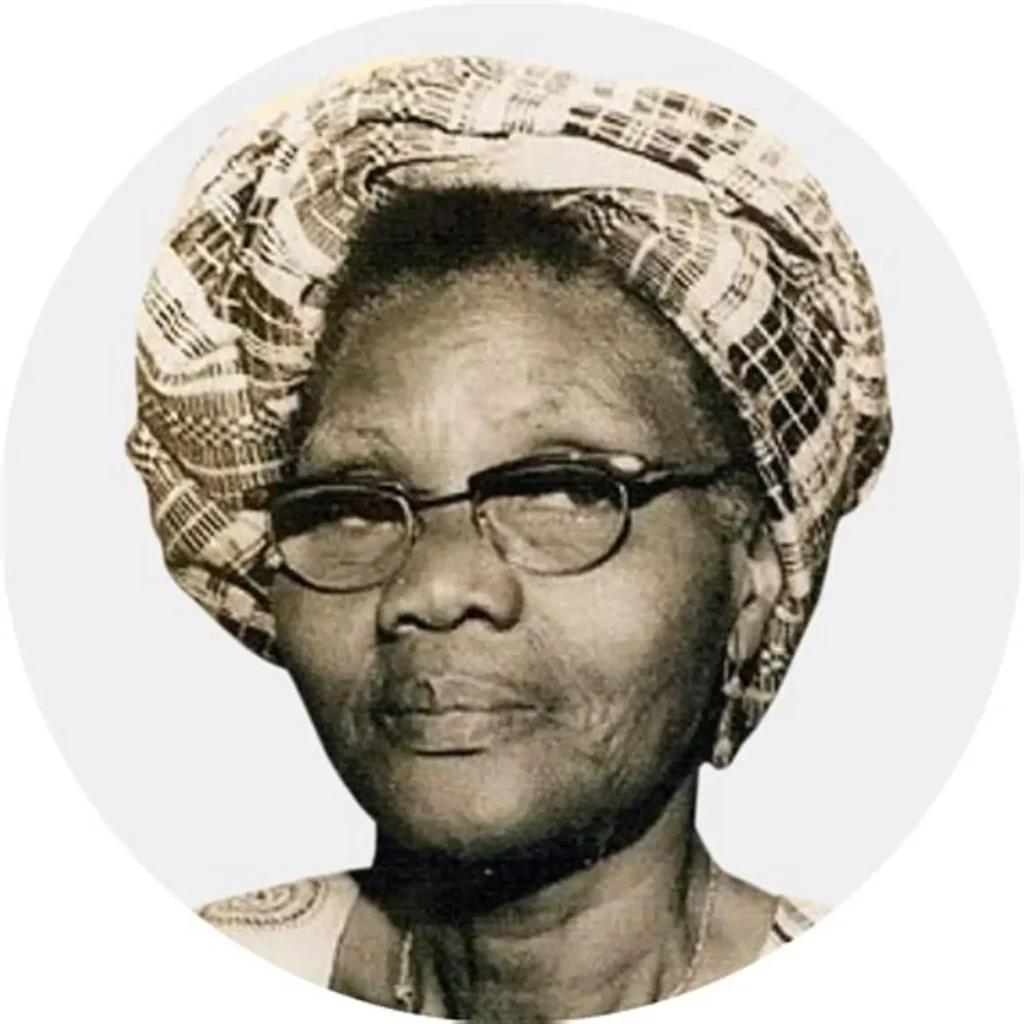
Funmilayo Ransome-Kuti was a Nigerian educator, political organizer, women’s rights campaigner and nationalist whose work connected education with political participation and social reform. Born in Abeokuta in 1900, she became one of the first girls admitted to Abeokuta Grammar School, later studied in England, returned to Nigeria as a teacher, and eventually built one of the country’s most influential women’s organizations.
She is best known for leading the Abeokuta Women’s Union (AWU) during the late 1940s campaign against unfair taxation and the exclusion of women from local political decision-making. Her activism also extended to women’s suffrage, education, Nigerian nationalism, Pan-African causes and international women’s organizations. The Oxford Research Encyclopedia of African History identifies her as a founder of both the Abeokuta Women’s Union and the Nigerian Women’s Union and describes her as an important figure in the development of African feminism and Nigerian political thought.
For students and researchers of Nigerian education, however, her significance goes beyond political protest. She began as a teacher, organized literacy opportunities for women, promoted women’s participation in public affairs and later took part in discussions about education and national development. Her life shows how education could function not only as formal schooling but also as a tool for citizenship, organization and social change.
Who Was Funmilayo Ransome-Kuti?
Funmilayo Ransome-Kuti was born Frances Abigail Olufunmilayo Thomas on October 25, 1900, in Abeokuta, in what is now Ogun State, Nigeria. She later adopted the Yoruba name Funmilayo and became widely known as Funmilayo Ransome-Kuti after marrying Reverend Israel Oludotun Ransome-Kuti.
She belonged to an educated Christian family in Abeokuta. Her father, Daniel Olumeyuwa Thomas, was associated with farming and produce trading, while her mother, Lucretia Phyllis Omoyeni Adeosolu, was a dressmaker. The family placed considerable value on education, at a time when opportunities for girls to receive formal schooling were far more restricted than they are today.
She eventually became known by the title Chief, reflecting her traditional and public standing, and was also associated with the title Oloye. Her public career combined teaching, community organizing, political activism and international women’s advocacy.
How Old Was Funmilayo Ransome-Kuti?
Funmilayo Ransome-Kuti was born on October 25, 1900 and died on April 13, 1978. She was 77 years old when she died.
She died in Lagos after suffering serious injuries during the February 1977 military raid on the Kalakuta compound of her son, musician Fela Anikulapo-Kuti. Historical accounts and archival material document the connection between the raid, her injuries and her subsequent decline in health.
Early Life and Family Background
Ransome-Kuti grew up in Abeokuta, a major Yoruba city with a long history of political organization, missionary education and commercial activity.
Her family’s commitment to education was particularly important. Formal schooling for girls was still uncommon in many parts of colonial Nigeria, yet her parents supported her education. She attended St. John’s Primary School in Abeokuta before moving to secondary education.
Her later family life also connected her to one of Nigeria’s best-known intellectual and activist families. She married Reverend Israel Oludotun Ransome-Kuti, an educator and Anglican clergyman, in 1925. Their children included Olikoye Ransome-Kuti, a physician and former Nigerian health minister; Fela Anikulapo-Kuti, the internationally known musician and political critic; Beko Ransome-Kuti, a physician and human rights campaigner; and Dolupo Ransome-Kuti, who became a nurse.
Her family connections were significant, but her own achievements were established independently through education, teaching and political organizing.
Educational Background
One of the most important facts about Ransome-Kuti’s educational history is that she was among the first female students admitted to Abeokuta Grammar School.
The school had previously been established primarily for boys. In 1914, when girls were admitted, she was among the first group of female students. Her attendance was significant because it placed her within an emerging generation of Nigerian women gaining access to formal secondary education.
After her education in Abeokuta, she traveled to England in 1919 for further study. She attended Wincham Hall School for Girls in Cheshire, where her studies included subjects such as music, French, domestic science, dressmaking and elocution. She returned to Nigeria in 1922.
Her time in Britain also exposed her to racial discrimination, an experience that has been discussed in biographies of her life. During this period she increasingly identified herself by her Yoruba name, Funmilayo, rather than the Christian names Frances and Abigail with which she had been christened.
There is no reliable evidence that she earned a university degree. Her formal education was primarily secondary and professional, followed by practical experience as a teacher and community educator.
Funmilayo Ransome-Kuti as a Teacher
After returning to Nigeria, Ransome-Kuti entered the teaching profession. She taught at Abeokuta Grammar School, the institution she had previously attended as a student.
Teaching became the foundation for the wider public work that followed.
She understood that literacy could change the position of people who were excluded from formal political institutions. Her educational work therefore extended beyond conventional classroom teaching. She became involved in literacy efforts for women, particularly women whose economic activities were concentrated in the markets and who had received little or no formal schooling.
This experience would later prove important when she began organizing market women. Her ability to communicate across educational and social classes helped her build an organization that included educated women as well as women from the trading communities of Abeokuta.
In this sense, her contribution to education was not limited to teaching children. She also treated adult literacy and access to information as part of women’s ability to participate in public life.
The Abeokuta Women’s Union
Ransome-Kuti’s most important organizational achievement was the development of the Abeokuta Women’s Union.
The organization grew from an earlier women’s group and became a much broader political movement. By 1946, the Abeokuta Women’s Union had adopted a clearly political orientation and was open to women from different social and economic backgrounds.
The union addressed taxation, market regulations, political representation and the treatment of women by the colonial administration and local authorities.
Ransome-Kuti’s educational background mattered here because the movement relied heavily on written petitions, correspondence, public meetings and engagement with official institutions. Women used literacy and organized communication as political tools.
The union eventually became a major force in Abeokuta, with membership commonly estimated at around 20,000 women.
What Was the Abeokuta Women’s Revolt?
The Abeokuta women’s movement became nationally known through its campaign against taxation imposed on women.
Women in Abeokuta faced a tax system that they considered discriminatory and unjust. The campaign was not simply about refusing to pay money. The protesters also challenged the political structure through which decisions were made without adequate representation for women.
The women used petitions, demonstrations, market closures, public meetings and other forms of organized protest. The movement eventually forced the authorities to suspend the women’s tax and contributed to the departure of Alake Ademola II from the throne in 1949.
The episode became an important example of organized women’s political action in colonial Nigeria.
It also demonstrated why education mattered to Ransome-Kuti’s activism. Her movement connected the ability to read and write with the ability to petition authorities, understand government decisions, organize communities and demand accountability.
Political Career and Nigerian Nationalism
Ransome-Kuti’s activism eventually expanded beyond Abeokuta.
She became involved with the National Council of Nigeria and the Cameroons (NCNC) and held leadership responsibilities within its women’s organization. She later helped establish the Commoners’ People’s Party. The Oxford Research Encyclopedia also records her participation in pre-independence political activity and her involvement in organizations advocating greater political rights for Nigerian women.
One of her long-term objectives was women’s political participation. She argued that women should not be expected to support political systems in which they had little meaningful representation.
Her activism therefore connected women’s rights with the broader Nigerian nationalist movement.
Role in Education Policy and Public Administration
Although she did not become a university professor or academic administrator, Ransome-Kuti remained involved in education beyond her early teaching career.
In 1969, she was appointed chairman of the Advisory Board of Education by the Western Nigeria state government. She also served as a consultant to the Federal Ministry of Education on the recruitment of teachers from other countries.
Her participation in education policy is important because it shows that her public career was not limited to street protest or party politics. She also contributed to institutional discussions about education and teacher recruitment.
Her broader educational philosophy was closely linked to access. She viewed education as something that should equip people to understand their rights, participate in society and improve their economic circumstances.
International Work and Women’s Rights
Ransome-Kuti eventually became an internationally recognized advocate for women’s rights and peace.
She was elected a vice president of the Women’s International Democratic Federation, an international women’s organization. She also led the Nigerian section of the Women’s International League for Peace and Freedom.
Her international activities placed Nigerian women’s concerns within broader debates about colonialism, racial equality, women’s political rights and peace.
She also supported anti-apartheid causes and maintained links with African nationalist movements. Her influence extended beyond Nigeria, particularly among women’s organizations interested in political participation and decolonization.
Awards and Honors
Ransome-Kuti received several major honors during her lifetime.
In 1965, she was awarded the Order of the Niger by the Nigerian government. The University of Ibadan awarded her an honorary Doctor of Laws degree in 1968. In 1970, she received the Lenin Peace Prize for her international work promoting peace and cooperation.
These honors reflected different dimensions of her public career, including Nigerian national service, women’s rights activism and international peace work.
The honorary doctorate from the University of Ibadan should not be confused with an earned academic doctorate. It was an honorary degree recognizing her public contribution.
Funmilayo Ransome-Kuti and the Kalakuta Raid
One of the most painful events in the final period of her life occurred on February 18, 1977, when Nigerian soldiers raided the Kalakuta compound associated with her son Fela.
During the raid, Ransome-Kuti was thrown from an upper floor and suffered serious injuries. She was subsequently hospitalized in Lagos and did not recover from the consequences of the attack. Archival accounts document her declining condition before her death on April 13, 1978.
Her death later became part of the political memory surrounding the military era in Nigeria. Fela responded through his music and public protests, making his mother’s treatment a central theme of his criticism of the military government.
What Is Funmilayo Ransome-Kuti’s Legacy in Education?
Her educational legacy rests on more than being an early female student and teacher.
She demonstrated how education could provide women with tools for organization and public participation. Her work with women who had limited formal schooling also showed the importance of adult literacy and accessible political information.
Her archival legacy is particularly valuable to researchers. Her personal papers, together with documents relating to her organizations and political activities, are held in the University of Ibadan Library’s Manuscripts Section. The collection includes correspondence, organizational documents and other primary materials that help scholars study women’s political activism and education in colonial and postcolonial Nigeria.
Researchers have continued to use these materials to examine women’s movements, political organization, colonial administration and the relationship between education and activism.
Funmilayo Ransome-Kuti’s Legacy Today
Although Ransome-Kuti died in 1978, her life remains part of Nigerian education, civic history and public discussion.
Her story has continued to appear in educational and cultural programs, including film screenings and public discussions involving university students. In 2024, for example, EiE Nigeria, WARDC and BudgIT organized screenings of a film about her in Lagos, Abuja and Abeokuta, with students from the University of Lagos and the Federal University of Agriculture, Abeokuta participating in discussions about civic engagement and social justice.
Her life has also remained a subject of new scholarship and cultural work in 2026. A private screening of the film Funmilayo Ransome-Kuti was included in the Nigerian Bar Association Section on Legal Practice’s 2026 annual conference program in Lagos.
These recent activities are not current roles held by Ransome-Kuti, who died in 1978. They are examples of how institutions continue to use her life to discuss women’s rights, citizenship, education and Nigerian history.
Frequently Asked Questions About Funmilayo Ransome-Kuti
Who was Funmilayo Ransome-Kuti?
Funmilayo Ransome-Kuti was a Nigerian educator, women’s rights activist, nationalist and political organizer. She is particularly known for leading the Abeokuta Women’s Union and its campaign against unfair taxation and political exclusion.
When was Funmilayo Ransome-Kuti born?
She was born on October 25, 1900, in Abeokuta, present-day Ogun State, Nigeria.
When did Funmilayo Ransome-Kuti die?
She died on April 13, 1978, in Lagos, at the age of 77.
What did Funmilayo Ransome-Kuti study?
She attended Abeokuta Grammar School and later studied at Wincham Hall School for Girls in Cheshire, England. Her studies in England included domestic science, music, French, dressmaking and elocution.
Was Funmilayo Ransome-Kuti a teacher?
Yes. After returning from England in 1922, she became a teacher and taught at Abeokuta Grammar School, the school she had attended as a student.
What was Funmilayo Ransome-Kuti best known for?
She was best known for leading the Abeokuta Women’s Union, campaigning for women’s political rights, opposing unfair taxation and participating in Nigeria’s nationalist movement.
Did Funmilayo Ransome-Kuti have a university degree?
There is no reliable evidence that she earned a university degree. Her documented formal education included secondary schooling at Abeokuta Grammar School and further studies at Wincham Hall School for Girls in England.
What awards did Funmilayo Ransome-Kuti receive?
Her major documented honors include the Order of the Niger in 1965, an honorary Doctor of Laws from the University of Ibadan in 1968, and the Lenin Peace Prize in 1970.
Was Funmilayo Ransome-Kuti related to Fela Kuti?
Yes. Fela Anikulapo-Kuti was her son. She was also the mother of physician and former Nigerian health minister Olikoye Ransome-Kuti, physician and human rights activist Beko Ransome-Kuti, and nurse Dolupo Ransome-Kuti.
Conclusion
Funmilayo Ransome-Kuti’s place in Nigerian history cannot be reduced to her family connection to Fela Kuti or to the famous women’s revolt in Abeokuta. Her own career began in education, and teaching provided the foundation for a much wider understanding of social change.
She was part of an early generation of Nigerian women who gained access to formal education and then used that education beyond the classroom. Through literacy work, women’s organization, political advocacy and participation in education policy, she demonstrated how knowledge could become a practical instrument for civic participation.
Her work also offers an important lesson for students of Nigerian education. Educational progress is not measured only by the number of schools, examinations or degrees. It can also be measured by whether people gain the knowledge and confidence to participate in decisions that affect their lives.
Ransome-Kuti died more than four decades ago, but her papers remain valuable to researchers, her educational story continues to be taught, and her political life continues to inform discussions about women’s rights, citizenship and Nigerian history. Her legacy therefore belongs not only to political history but also to the history of education and the struggle for wider access to public life.


No comments yet. Be the first to share your thoughts.